Success Stories
HZB expertise in Garmin Watches

Wysips® technology can, for example, be integrated into a wristwatch to supply it with some or all of its power. © Garmin
Franck Aveline, Vice-President Consumer Product Line, Garmin (former Sunpartner):
“Our partners at HZB have understood our vision and have already supported us over the past few years with their expertise and technical capabilities in the field of thin-film photovoltaics. This agreement marks a new step that we are taking together to bring Wysips® solutions to market,” says Franck Aveline, Vice-President of the Consumer Product Line at Sunpartner Technologies.
HZB’s expertise in solar modules from Oxford PV
Dr. Simon Kirner, Development, Oxford PV
““The collaboration has gone very well for us at Oxford PV so far. We have always received the bottom cells and the measurement results from HySPRINT very quickly. The collaboration with HySPRINT is extremely valuable to us, as it enables us to obtain timely insights into the quality of the tandem solar cells, which support our own research and have led to very high efficiencies. As part of this collaboration, we have succeeded in securing funding for another major research project (‘ProTandem’). We look forward to continuing our collaboration.”
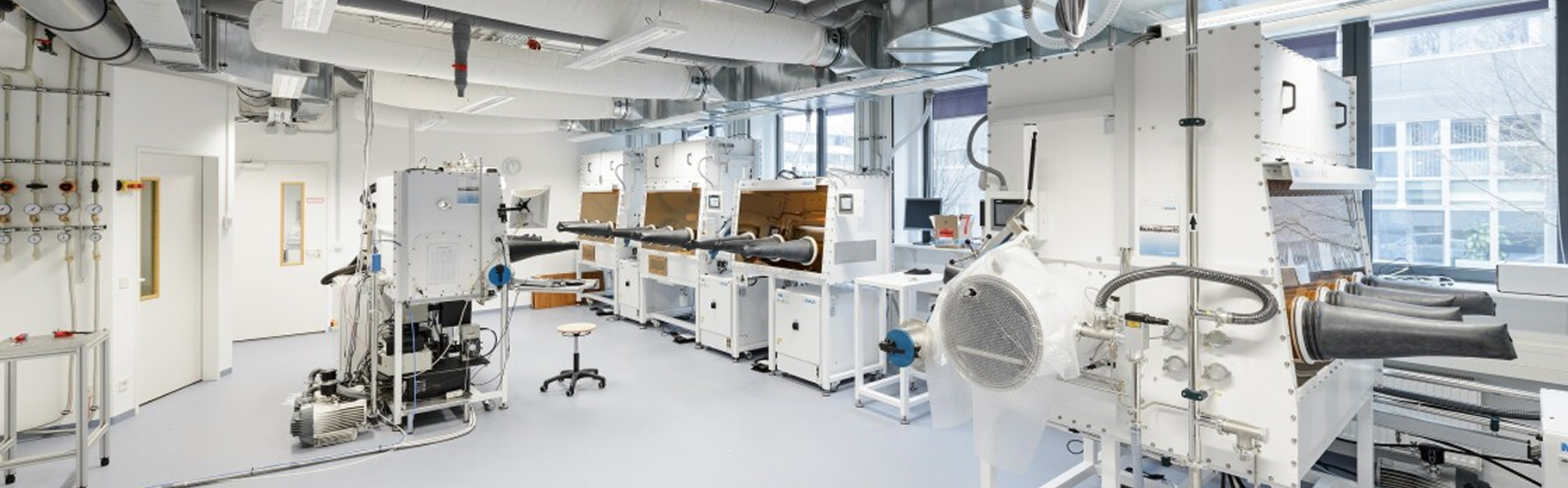
A view inside the HySPRINT laboratory at HZB, where researchers manufacture, measure and test perovskite solar cells.
Photo: HZB/M. Setzpfandt
Protons cure eye tumours
Dr. Jens Heufelder, Medical physicist Charité – Universitätsmedizin Berlin
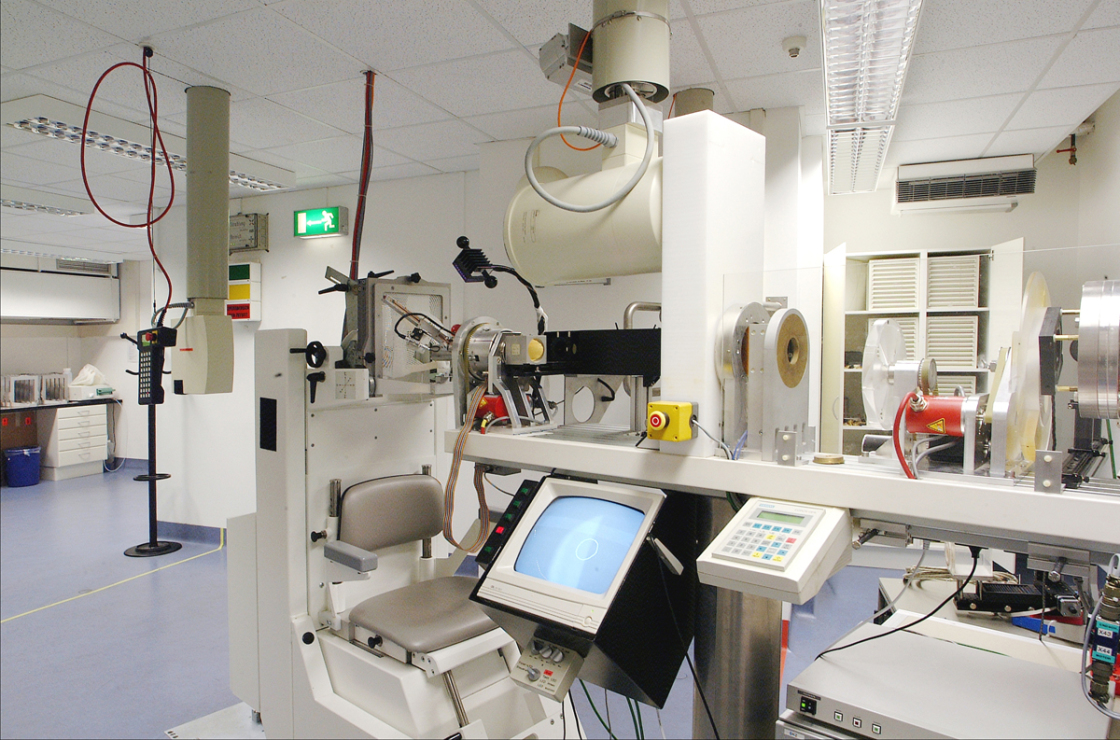
“Proton radiation therapy is a particularly effective method: the energy of the proton beam can be adjusted so that virtually only the tumour is exposed to the radiation. As protons travel in a straight line, lateral scattering is much less than with X-rays.”

LightHouse Project with Research Instruments (RI)

The images show a polished molybdenum puck (left) prior to chemical vapour deposition, which is subsequently coated with a black, light-absorbing layer (right). © Research Instruments GmbH
Quote from a press release issued by RI:
“At RI in Bergisch Gladbach, we are currently setting up the beam test facility to demonstrate the feasibility of the LightHouse electron accelerator. As the electron source, we are using a photocathode in which a pulsed green laser beam (515 nm, 40 W) strikes a carefully prepared bi-alkali antimonite film, releasing electron pulses into the vacuum. “The fabrication of such photocathodes is an art in itself, but thanks to close collaboration with Cornell University and the Helmholtz Centre Berlin, we have mastered vacuum deposition and learnt to fabricate the photocathodes ourselves.”
HZB Technology Transfer Award

Picture: Adobe Stock
Call
In recognition of outstanding achievements in the field of technology transfer, the Helmholtz-Zentrum Berlin awards the Helmholtz-Zentrum Berlin Technology Transfer Award, which carries a total prize fund of 10,000 euros. The jury consists of the HZB’s Industry Advisory Board.
Through this award, HZB aims to recognise and promote the achievements of current or former staff members who have transformed ideas from research and development into new services, processes and products.
The key criteria are the idea, the degree of innovation and the market potential of the project. In assessing market potential, the jury will take the following sub-criteria into account: application prospects, industrial projects, intellectual property rights, concluded industrial contracts, industrial revenue and spin-offs.
History of the HZB Technology Transfer Award
- Winner Technology Transfer Award 2025
- Winner Technology Transfer Award 2023
- Winner Technology Transfer Award 2021
- Winner Technology Transfer Award 2019
Application Procedure
Please describe your project in a way that is easy to understand, on a maximum of two A4 pages. Where appropriate, the description may be supplemented with illustrations (drawings, photographs). To facilitate the assessment, you may also refer to further reading or specialist references. Please also state whether you have evidence or relevant documentation to assess the market potential of your project, which may be requested by the jury members if necessary. In the case of group applications, the prize money will be divided equally amongst the named participants.