
Joint Research Group - SyncLab
News
25.07.2026: New InterDent publication
27.06.2026: SyncLab is extended for another 3 1/2 years!
We are happy to announce that our joint research group 'Combined X-ray methods at BLiX and BESSY II – SyncLab (PS-GSYN)' between HZB and TU Berlin has been further extended from 1.7.2026 till 31.12.2029. We will continue to work on the combination of lab and synchrotron experiments for the optimized and sustainable use of instrumentation. Another focus is the involvement of our research group in the planning of the future BESSY III facility, especially concerning the concept of an integrative research campus and auxilliary lab infrastructures.
9.06.2026: New publication and HZB Science highlight
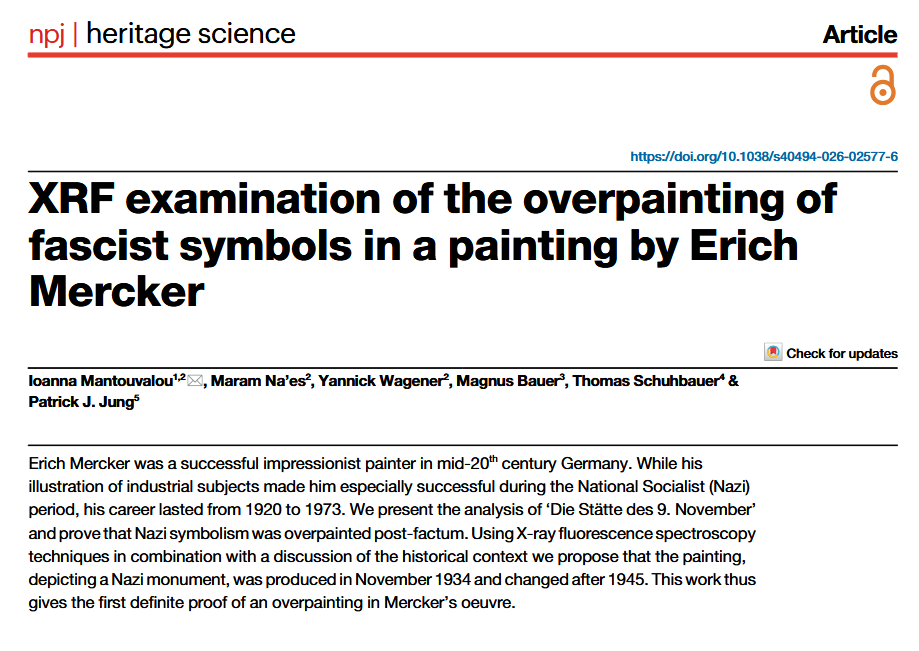
We used XRF imaging to prove the overpainting of fascist sysmbols in an oil painting of Erich Mercker. See also the HZB science highlight on 8.06.2026.
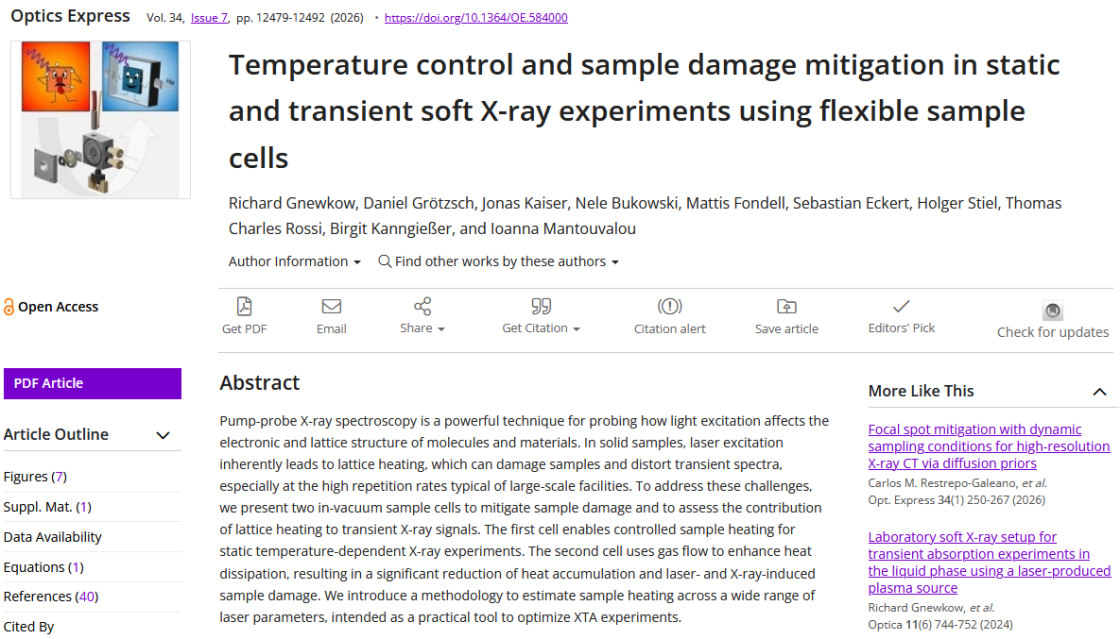
06.04.2026: New publication and Optics Express editors pick
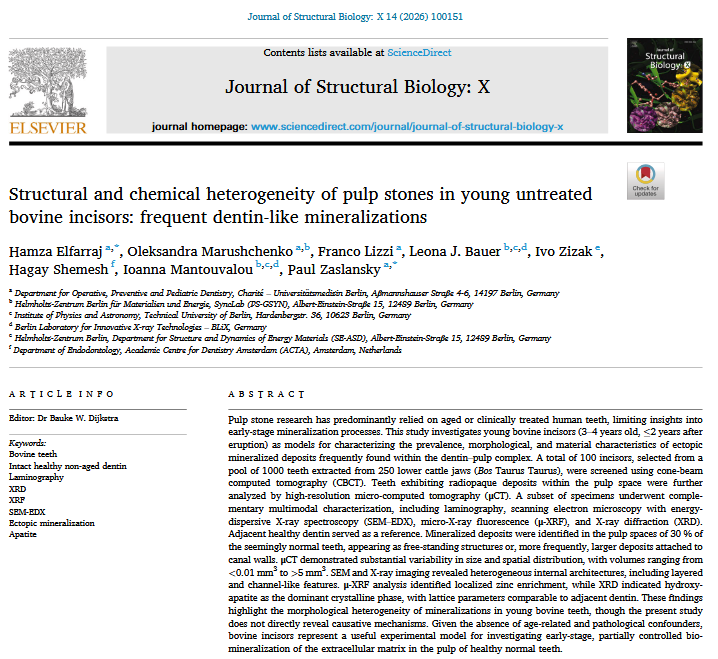
19.02.2026: New publication and HZB Science highlight
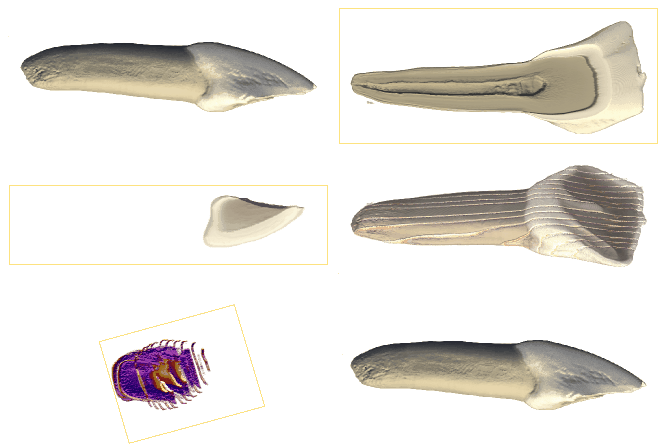
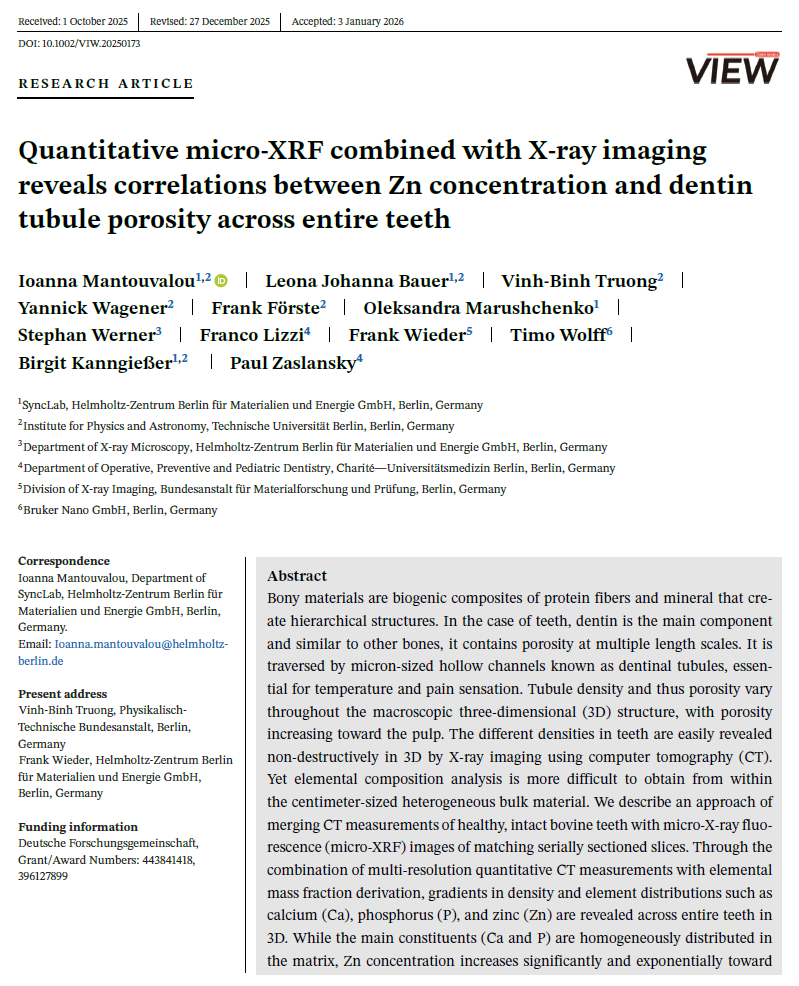
Within the DFG funded research group InterDent, we published a correlative work on combining XRF and CT for the structural and chemical analysis of bovine teeth. See also the HZB science highlight on 19.02.2026.
14.01.2026: New publication

In a fruitful cooperation with the Max Planck Institute of Colloids and Interfaces we have investigated the role of Zn in biofilms mineralization. Check out the details here.
14.10.2025: Arte Documentary 'Geraubtes Wirtschaftswunder - Die übertünchte Vergangenheit der Deutschen'
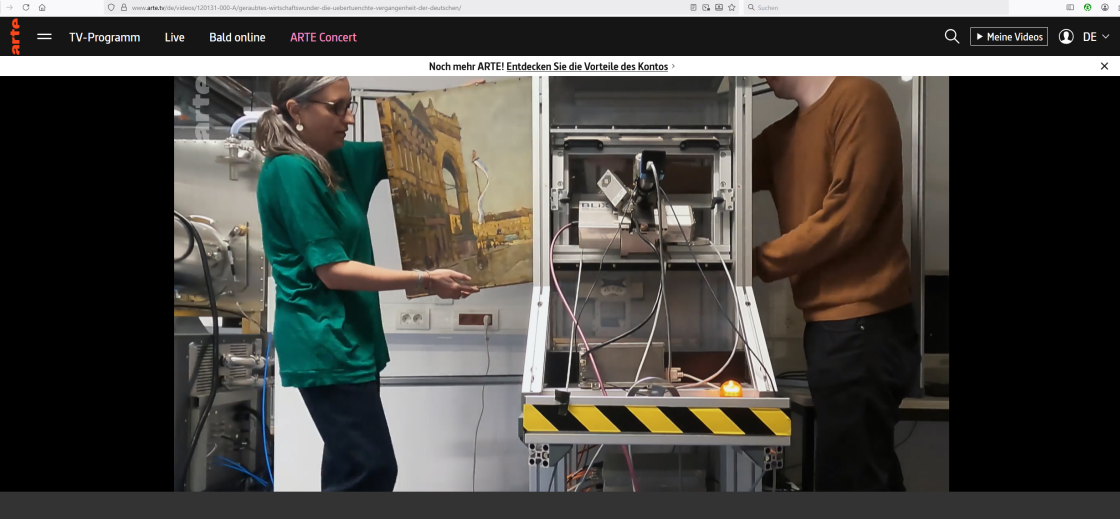
Last year, we investigated an oil painting using XRF spectroscopy at the BLiX and the suprising results became part of an arte documentary. Today, the production 'Geraubtes Wirtschaftswunder - Die übertünchte Vergangenheit der Deutschen' is available at www.arte.tv and will be shown on live TV at 20:15.
19.09.2025: DFG FOR2804 InterDent Status Update Meeting

Our DFG research group InterDent had the latest Status Update Meeting at the Adlershof Campus of HZB. We had a great day at HZB with fruitfull discussions and scientific exchange between scientists form HZB, TU Berlin, MPIKG, ZIB, Uniklinik Halle and the Zahnklinik of the Charité Berlin.
A big thanks to Katja Frenzel from the PTB and Dr. Stefan Werner from HZB for giving tours of their instruments.
08.07.2025: New publication
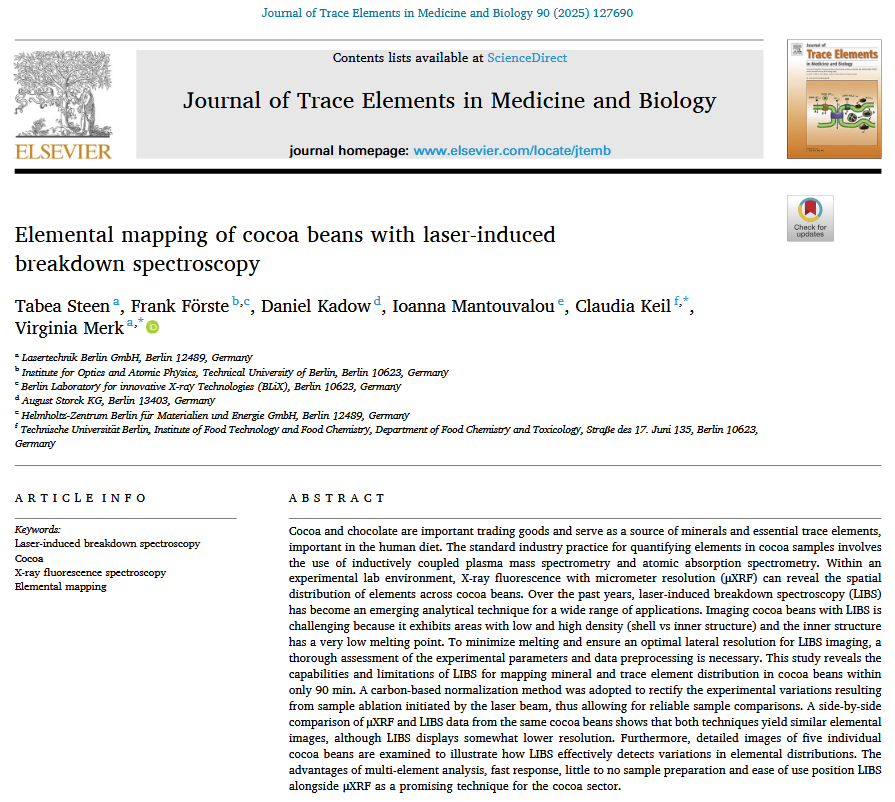
Our cooperation partners show the feasibility to use LIBS for elemental imaging of cocoa beans.
05.05.2025 New FlatJet for NEXAFS measurements in solution

Our new FlatJet from Advanced Microfluidic Systems GmbH is now operational and can be used together with our laboratory NEXAFS system.
18.04.2025: New publication and HZB Science highlight

Ioanna Mantouvalou published her work on the analysis of elemental migration in Li-ion batteries. Using confocal micro-XRF the analysis is possible operando and for long periods of time. See also the HZB science highlight on 29.04.2025.
27.03.2025: New publication

PhD candidate Frank Förste published his new results on the quantification of confocal micro-XRF data. He introduces the first application of a neural network for the quantification of homogeneous bulk samples, which significantly simplifies the evaluation and effectively eliminates the need for human input.
Former news
-
25.02.2025 SyncLab is extended by 1 year!
-
27.11.2024 BLiX Satellite-Meeting at PRORA 2024
-
20.11.2024 Leona Bauer successfully defended her PHD, congratulations!
Title: Enabling 3D elemental analysis of composite dental materials using laboratory confocal micro X-ray fluorescence spectroscopy -
08.07.2024 DFG research group InterDent is funded for the second term!
-
24.06.2024 New Method for Absorption Correction to Improve Dental Fillings - HZB Science Highlight
-
23.05.2024 Dynamic measurements in liquids now possible in the laboratory - HZB Science Highlight
-
06.04.2023 How much cadmium is contained in cocoa beans? HZB Science Highlight
-
10.03.2023 We are looking for a motivated student wo is interested in a master thesis between physics and data science.
-
08.10.2021 job offer for PHD position in the DFG research group InterDent
deadline: 05.11.2021 -
04.06.2021 BESSY Science Seminar: From the synchrotron into the mouth: integrative X-ray techniques at HZB reveal clinically important hidden tooth zones
-
25.02.2021 Workshop analytical X-ray physics
-
07.01.2021 presentation in the Global XAS Journal Club
-
21.09.2020 HZB and TU Berlin: SyncLab new joint research group at BESSY II