
Öffnet in neuem Fenster Opens in a new window Öffnet externe Seite Opens an external site Öffnet externe Seite in neuem Fenster Opens an external site in a new window

Institute Solar Fuels

Ongoing Projects

SANS-F

Fluorine-free polymer membranes for photoelectrolyzers and redox-flow batteries

The Helmholtz-Zentrum Berlin for Materials and Energy (HZB) and Friedrich Schiller University Jena (FSU Jena) are jointly pursuing an innovative and targeted approach in the field of energy storage and conversion, within the framework of HIPOLE (Helmholtz Institute for Polymers in Energy Research), jointly funded by HZB and FSU. SANS-F is supported by the Free State of Thuringia through the Thüringer Aufbaubank (TAB) and the European Social Fund Plus.

TAB - Grant agreement: 2024 FGR 0021
Duration: 01.01.2025 - 31.12.2028
ongoing project: SANS-F

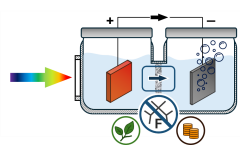
Conventional membrane materials are still often made from fluorinated polymers. The EU Commission’s ban on PFAS has made it clear that a technology can only be truly sustainable if it is also based on sustainable materials [1]. The central objective of the SANS-F research group is therefore to develop fluorine-free polymer materials that can be produced using the most sustainable synthesis routes possible and used in photoelectrochemical cells (PEC) and organic redox flow batteries (RFB). To this end, the consortium will develop a materials platform that enables the modular design of diverse polymer membranes. In-depth membrane characterization will provide the understanding needed to tailor polymer membranes to specific applications [2, 3, 4].
For this purpose, synthetic approaches to produce two different membrane types will be developed and transferred to supported/reinforced systems. Characterization across multiple length scales will elucidate the molecular structures and morphology of the materials. Finally, testing the membranes in PEC and RFB systems will demonstrate the fundamental suitability of the materials.

[1] D. Zukova, M. D. Hager, F. H. Schacher, R. van de Krol, U. S. Schubert, M. Favaro, ACS Polym. Au, 5 (6), 756–780 (2025). DOI: 10.1021/acspolymersau.5c00089

[2] M. Ralaiarisoa, S. S. Krishnamurti, W. Gu, C. Ampelli, R. van de Krol, F. F. Abdi, M. Favaro, J. Mater. Chem. A, 11, 13570-13587 (2023). DOI: 10.1039/D3TA02050A

[3] B. Albakri, A. Turski Silva Diniz, P. Benner, T. Muth, S. Nakajima, M. Favaro, A. Kister, Electrochim. Acta 496, 144474 (2024). DOI: 10.1016/j.electacta.2024.144474

[4] M. Favaro, H. Kong, R. Gottesman, J. Phys. D: Appl. Phys., 57 103002 (2024). DOI: 10.1088/1361-6463/ad10d3

OHPERA

Optimized halide perovskite nanocrystalline-based photoelectrolyzer for clean, robust, efficient, and decentralized production of H2

OHPERA has been financed under the European Innovation Council (EIC) Pathfinder Challenge: Novel routes to green hydrogen production. Together with other 8 projects, OHPERA is part of the EIC H2 portfolio.

EIC - Grant agreement: 101071010
Duration: 01.01.2023 - 31.03.2026
ongoing project: OHPERA

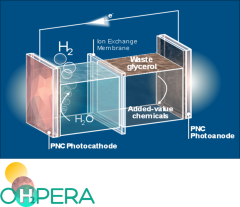
Photoelectrochemical (PEC) H2 generation, using water as proton and electron source, is considered the most impactful solar-driven processes to tackle the energy, environment, and climate crisis, providing a circular economy strategy to supply green energy vectors (H2) with zero carbon footprint [1]. Aligning with this view, OHPERA will develop a proof-of-concept unbiased tandem PEC cell to simultaneously achieve efficient solar-driven H2 production at the cathode and high added-value chemicals from valorisation of industrial waste (glycerol) at the anode [2, 3], being sunlight the only energy input. Thus, OHPERA will demonstrate the viability of producing chemicals with economic benefits starting from industrial waste, using a renewable source of energy. At HZB, we have the lead of the “Proof-of-concept device development” work package. We are developing an integrated tandem device for H2 evolution and glycerol oxidation [4] based on the developed photoelectrodes from the consortium, with the theoretical inputs from the modelling of photoactive and photoelectrocatalytic materials.

1] J. Garcia-Navarro, M. Isaacs, M. Favaro, D. Ren, W.-J. Ong, M. Grätzel, P. Jiménez-Calvo, Global Challenges, 8 (6), 2300073 (2023). DOI: 10.1002/gch2.202300073.

[2] H. Kong, S. Gupta, A. F. Pérez-Torres, C. Höhn, P. Bogdanoff, M. T. Mayer, R. van de Krol, M. Favaro, F. Abdi, Chem. Sci., 15 (27), 10425-10435 (2024). DOI: 10.1039/D4SC01651C.

[3] A. F. Pérez-Torres, H. Kong, F. Abdi, R. van de Krol, M. Favaro, Chem. Commun., 61 (10), 2083-2086 (2025). DOI: 10.1039/D4CC04967E.

[4] A. F. Pérez Torres, H. Kong, S. S. Krishnamurti, F. Liang, S. Gimenéz, R. van de Krol, M. Favaro, Energy Fuels, 39 (26), 12716-12730 (2025). DOI: 10.1021/acs.energyfuels.5c01590