
Department Materials Chemistry for Catalysis
Our Projects
Ongoing Projects
AI-driven Catalyst Discovery
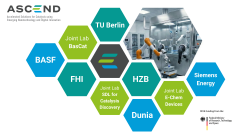
The Helmholtz-Zentrum Berlin (HZB), together with the Fritz-Haber-Institut (FHI), BASF, Dunia Innovations, Siemens Energy, and the Technische Universität Berlin (TU Berlin / BasCat), has launched the ASCEND project (Accelerated Solutions for Catalysis using Emerging Nanotechnology and Digital Innovation), supported by €30 million funding from the German Federal Ministry for Science, Technology and Space. The five-year initiative focuses on accelerating catalyst discovery for sustainable chemical manufacturing and the defossilisation of energy-intensive industries. ASCEND combines AI-driven “Digital Catalysis” — integrating machine learning, simulations, and self-driving laboratories — with advanced thin-film and nanostructured catalyst technologies to rapidly identify high-performance materials. By linking automated experimentation with real-world validation under industrial conditions, the project aims to deliver efficient, scalable catalysts for green hydrogen, synthetic fuels, and base chemicals, thereby bridging the gap between fundamental research and large-scale industrial application.
CatLab – Catalysis Laboratory
The Helmholtz-Zentrum Berlin (HZB), together with the Fritz-Haber-Institut (FHI) of the Max-Planck-Gesellschaft and the Max-Planck-Institut für Chemische Energiekonversion (CEC), has launched a cutting-edge catalysis platform known as CatLab. By combining their strengths in catalysis research, thin-film and nanotechnology, and operando analysis, these institutions are driving forward research that is crucial for the sustainable energy transition. In close cooperation with the Humboldt University of Berlin, leading researchers from the UniSysCat cluster, and industrial partners, CatLab is generating pioneering scientific insight and developing essential technological building blocks for a green hydrogen economy. A central innovation of CatLab is its focus on tailor-made thin-film catalysts instead of conventional powdered catalysts. These bespoke layers can be engineered precisely for target processes, offering more efficient and selective catalysis. At HZB, our group contributes to CatLab by investigating the fundamental structure–property relationships in these thin-film catalysts. Specifically, we study how the atomic and electronic structure of the films evolves under reaction conditions — for example, during water splitting, selective organic oxidation and CO₂ reduction — using operando techniques. These insights are crucial for optimizing catalyst performance, stability, and selectivity. Through operando analysis at HZB’s facilities (notably leveraging the BESSY II synchrotron), we can observe in real time how catalyst surfaces restructure, how intermediate species are formed, and how kinetic and thermodynamic factors interplay. By integrating advanced synthesis, in situ/operando diagnostics, and data-driven design (including automated evaluation and machine learning), CatLab accelerates the rational development of next-generation catalysts. The overarching goal is to bridge fundamental research and industrial application, supporting a climate-neutral energy future.
GreenQUEST Project – Fuel for Life

The GreenQUEST project is a German–African initiative aimed at establishing a sustainable and economically viable pathway for producing a carbon-neutral liquefied fuel (g-LFG) as a clean replacement for fossil LPG in off-grid communities. The project addresses the full value chain—from renewable energy input to CO₂ conversion, fuel synthesis, storage, distribution, and socio-economic assessment—to deliver a scalable and environmentally sound energy solution. A central scientific focus of GreenQUEST is the efficient generation of syngas (CO2/CO/H2) from CO2 and H2O. Instead of relying solely on conventional thermo-catalytic approaches, GreenQUEST advances electrocatalytic CO2 reduction and water electrolysis to produce tailored syngas mixtures with higher efficiency and compatibility with decentralized renewable energy. These syngas streams are then catalytically converted to dimethyl ether (DME) and finally to g-LFG, requiring the development of new, knowledge-driven catalyst systems. Within this framework, the Helmholtz-Zentrum Berlin (HZB) contributes expertise in thin-film catalysis, materials design, and operando spectroscopy, using the BESSY II synchrotron to probe catalyst structure and reaction mechanisms under real operating conditions. Our laboratory leads the electrochemical part of the project, focusing on the front-end conversion of CO2 and H2O. We develop silver-based electrocatalysts for selective CO2-to-CO conversion and copper-based catalysts for methanol, alongside electrode materials for efficient green hydrogen production via water electrolysis. Through operando X-ray and vibrational spectroscopy coupled with electrochemical studies, we establish key structure–property relationships that guide the design of active and stable electrocatalysts. Together, these contributions lay the scientific foundation for producing a clean, CO2-neutral, high-performance fuel, supporting a sustainable energy transition for Africa and beyond.
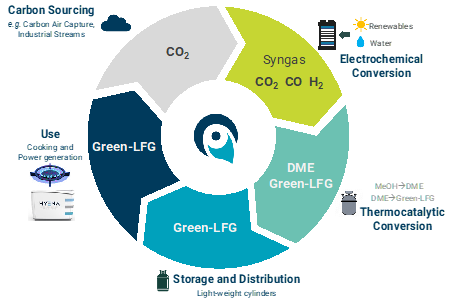
PHOTO-ELECTRO INTEGRATED NEXT-GENERATION ENERGY TECHNOLOGIES (PHOENIX-GEN)

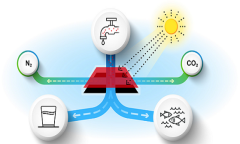
The PHOENIX project is an EU-supported initiative that aims to convert CO2 and PET plastic waste into high-value chemicals using an integrated electrochemical (EC) and photoelectrochemical (PEC) approach, supporting the objectives of the EU Green Deal and REPower EU. By combining renewable energy input with advanced catalytic technologies, PHOENIX addresses pressing environmental challenges, including greenhouse gas accumulation and plastic pollution, while advancing sustainable chemical production and increasing the technology readiness level (TRL) of CO₂ utilization and plastic recycling technologies. The project focuses on two major conversion pathways: CO2 to n-propanol and PET plastic derived ethylene glycol to glycolic acid (GA). Conventional methods for producing n-propanol and GA are energy-intensive and carbon-intensive, relying on high-pressure, high-temperature hydroformylation or formaldehyde carbonylation. PHOENIX introduces a solar-driven, multi-reactor strategy integrating PV-EC and PEC systems to achieve efficient, selective, and sustainable production of these target molecules, with scalability and ecological sustainability as central objectives. Within this framework, the Helmholtz-Zentrum Berlin (HZB) contributes critical expertise in electrocatalysis, thin-film materials, and operando characterization, enabling the rational design of catalysts that maximize activity, selectivity, and stability for both anodic and cathodic reactions. Our laboratory focuses on the electrochemical oxidation of ethylene glycol to glycolate, aiming for high efficiency and selectivity using optimized catalysts. This anodic process is strategically integrated with cathodic CO2 reduction to n-propanol at high current densities, ensuring long-term stability and durability. Using operando X-ray and vibrational spectroscopy, alongside electrochemical diagnostics, we investigate the structure–property relationships that govern catalyst performance under realistic reaction conditions, providing mechanistic insight essential for system optimization. By combining advanced electrochemical strategies with HZB’s infrastructure, our work contributes to establishing a robust, solar-driven platform for simultaneous CO2 and plastic waste valorization, supporting the broader goals of PHOENIX in carbon-neutral chemical production and sustainable energy utilization.

Pollutant removal during wastewater treatment through photocatalytic decomposition
Water contamination by trace substances represents one of the greatest impairments to the natural use of water worldwide. Even after conventional wastewater treatment and current regulations, many trace substances remain in the water cycle. The aim of this project is therefore to eliminate these remaining pollutants through further purification. To this end, a novel technology for the efficient and cost-effective removal of anthropogenic organic trace substances (e.g., pesticides or pharmaceuticals) in the fourth purification stage of water treatment will be validated. This purification is achieved through photocatalytic decomposition, which removes the pollutants from the cycle and thus prevents their accumulation. For the first time, Keplerates (POM, MoFe cluster compound), patented by TU Berlin, will be used as a photocatalyst. Based on this technology, it will be further developed and tested against practically relevant target specifications. Following successful validation, licensing models, a spin-off company, or a combination of both will be pursued.

This collaborative project, led by Prof. S. C. Peter at JNCASR (India) in partnership with Prof. P. W. Menezes HZB (Germany), focuses on designing advanced intermetallic electro(pre)catalysts to produce green hydrogen more efficiently. By coupling the hydrogen evolution reaction with the selective electrooxidation of biomass-derived organic molecules, the research aims to drastically lower energy consumption while generating valuable chemicals. The team integrates state-of-the-art in-situ/operando characterization and computational modeling to uncover active sites and reaction mechanisms. The project also emphasizes scalable catalyst synthesis and reactor design, paving the way for industrial-level hydrogen and organic chemical production.